
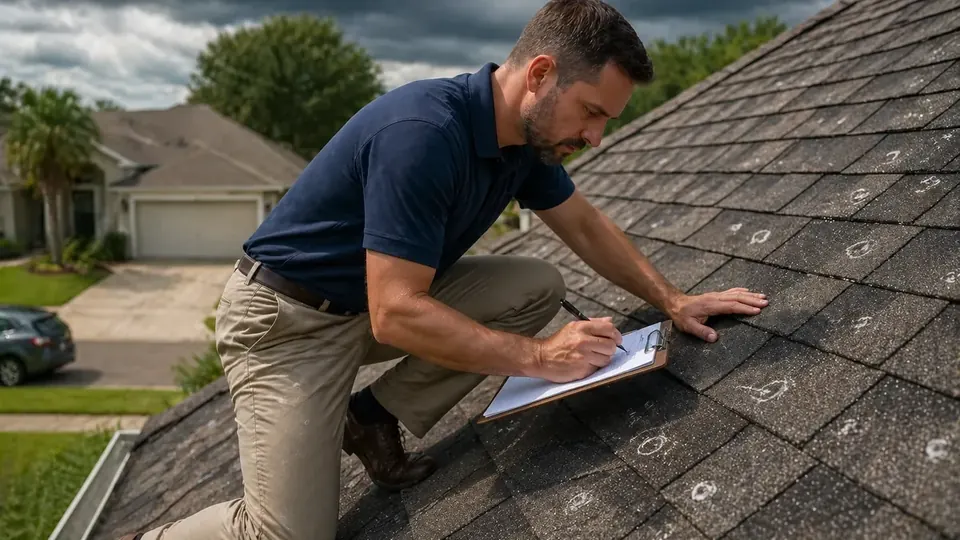
Roof damage insurance claims in McAllen usually begin with a storm: spring hail, a summer microburst, or heavy rain from a tropical system. The roof is the most expensive single component on many claims, and it is also where insurer and policyholder estimates tend to differ the most. A reliable roof insurance estimate McAllen property owners can stand behind needs accurate measurements, correct materials, and every line item a proper re-roof requires.
Local construction matters here. Most McAllen homes are slab-on-grade with composition shingle roofs, some with clay or concrete tile, and many outbuildings and commercial buildings use metal panels or flat and low-slope membranes. Each roof type fails differently, and each raises different claim questions.
Types of Roof Damage Covered
| Roof type | Typical storm damage | Common claim questions |
|---|---|---|
| Composition shingle | Hail bruising, granule loss, creased or missing tabs from wind | Repair vs. replace, matching, age-based depreciation |
| Clay or concrete tile | Cracked or broken tiles, displaced ridge pieces | Availability of matching tile, breakage during repair |
| Metal (residential and outbuildings) | Dents, seam separation, lifted panels, fastener failure | Cosmetic damage exclusions, panel replacement |
| Low-slope commercial (TPO, modified bitumen, built-up) | Membrane punctures, wet insulation, flashing failures | Moisture surveys, full system vs. patch, business interruption |
Damage caused by hail is covered in more depth on our hail damage claims page, and wind-driven damage on our wind damage claims page.
Typical Documentation for a Roof Claim
- Date-stamped photos of each roof slope, close-ups of damage, and interior ceiling stains.
- Roof measurements (squares, pitch, ridge, valleys, eaves, rakes) and number of layers.
- Material details: shingle brand and line, tile profile, metal gauge, or membrane type.
- Storm data for the date of loss. Our storm lookup and weather events pages can help.
- An itemized estimate, commonly prepared in Xactimate, with tear-off, disposal, underlayment, flashing, drip edge, vents, and permits.
- Your policy, declarations page, and any roof-specific endorsements.
What a Thorough Roof Inspection Covers
A carrier’s first inspection is sometimes brief, especially after a large storm when adjusters are handling many claims at once. A thorough roof inspection usually looks at:
- Every slope, not just one test square. Hail and wind damage are often uneven, with more damage on the side facing the storm.
- Soft metals and accessories. Dents on vents, pipe jacks, ridge vents, and gutters help confirm hail size and direction.
- Seal strips and fasteners. Wind can break the bond on shingles without removing them, leaving tabs that lift in the next storm.
- Decking and attic. Daylight, stains, and wet insulation show where water entered.
- Layers and material age. Multiple layers, brittle shingles, or discontinued products affect whether repair is feasible.
Recording these details early creates a clear record to compare against the insurer’s scope.
Common Claim Issues and Insurer Arguments
- Age and wear. The insurer says damage is from deterioration, thermal cracking, or installation defects rather than a storm.
- Undercounted damage. A small number of hits in a test square leads to a repair-only scope.
- Matching. Discontinued shingles or tile cannot be matched, yet the estimate covers only individual slopes.
- Missing items. Steep or high-roof charges, starter strip, ridge cap, step flashing, detach-and-reset of solar or satellite equipment, and permit costs are left out.
- Pricing. Unit costs do not reflect local market pricing after a widespread storm.
Our article on how to review an underpaid roof insurance estimate walks through these items.
Insurance Settlement Considerations
A roof settlement depends on more than the damage itself:
- Deductibles. Wind/hail deductibles are often a percentage of the dwelling limit; named-storm deductibles may also apply. Check your declarations page.
- Depreciation. On replacement cost policies, insurers typically pay ACV first and release recoverable depreciation after the roof is replaced. ACV-only roof endorsements and roof payment schedules can reduce what you receive.
- Ordinance or law. McAllen adopted the 2024 International Residential Code and International Building Code effective January 1, 2026. Code-required items beyond the original construction are paid only to the extent your policy covers ordinance or law. See McAllen building codes and how building codes affect insurance repairs.
- Limits. Detached garages, carports, and sheds fall under other structures coverage with a separate limit.
How a Public Adjuster May Help
A public adjuster in McAllen works for the policyholder. On a roof claim we may inspect and measure the roof, document damage slope by slope, compare the carrier’s scope with what the repair actually requires, and present a supplement when items are missing. If the insurer has already paid, an estimate review can identify gaps; if the claim is underpaid, see underpaid insurance claims. Under Texas law, a public adjuster may not take part in repairing a property on a claim they adjust, so we do not act as your roofer. We cannot promise a particular result. Fees are disclosed in a written contract before any work begins; Texas law caps public adjuster compensation at 10% of the insurance settlement.
Policyholder Responsibilities
- Report the damage promptly and keep a record of your claim number and contacts.
- Protect the property from further damage with tarps or temporary repairs, and save receipts.
- Do not discard damaged roofing materials before the insurer has had a chance to inspect.
- Provide a sworn proof of loss when requested and within the policy’s timeframe.
- Allow reasonable inspections and respond to document requests.
Applicable Policy Limitations and Exclusions
Roof claims are often limited by exclusions for wear and tear, deterioration, faulty workmanship, and long-term leaks; cosmetic damage endorsements on metal roofs; ACV-only roof coverage or payment schedules; and deadlines to complete repairs before recoverable depreciation is released. Policies may also set a deadline to file suit. For legal questions about deadlines or disputes, consult a Texas attorney.
Frequently Asked Questions
Does homeowners insurance cover roof replacement in McAllen?
Policies generally cover sudden, accidental damage from covered perils such as hail and wind. They do not cover wear, age, or poor maintenance. Whether a covered loss supports full replacement or repairs depends on the damage and your policy terms.
What is a roof payment schedule?
Some Texas policies pay roof losses based on a schedule tied to the roof’s age and material rather than full replacement cost. If you have one, the payment can be substantially lower than the cost to replace. Check your endorsements.
Do I need a permit to replace my roof in McAllen?
Re-roofing generally requires a building permit in McAllen. Confirm the scope with the City of McAllen Building Permits & Inspections department before work begins.
Will insurance pay for code upgrades like new underlayment or drip edge?
Only if your policy includes ordinance or law coverage, and only up to its limit. Some items may already be part of a standard re-roof scope. See our local building codes page.
Can you help with a commercial flat roof claim?
Yes. Low-slope roofs on retail, office, and warehouse buildings often involve membrane punctures, wet insulation, and interior damage. See our commercial property claims page.
My roofer and the insurer disagree on the damage. What now?
A public adjuster can review both scopes and the policy, request a re-inspection, and present supporting documentation. If the dispute is over the amount of loss, appraisal may be an option under the policy.