
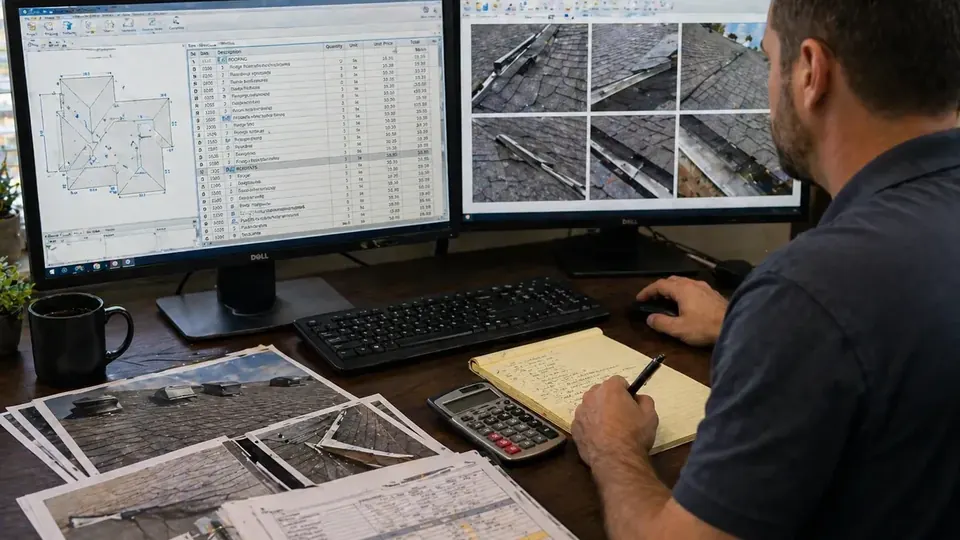
After an inspection, most insurers send a multi-page estimate full of codes, abbreviations, and columns. If you have a roof insurance estimate in McAllen and are not sure whether it covers what your roofer says is needed, you are not alone. An estimate review breaks the document down line by line and compares it with the actual damage and local repair costs. We review estimates for homeowners and business owners across McAllen, Hidalgo County, and the Rio Grande Valley (RGV), and we use Xactimate ourselves when preparing claim estimates.
Types of Property Damage Estimates We Review
- Roof estimates for composition shingle, metal, tile, and low-slope commercial roofs. See roof damage claims.
- Hail estimates that include exterior elevations, windows, gutters, and HVAC. See hail damage claims.
- Interior water estimates covering drying, drywall, insulation, flooring, and cabinets.
- Fire and smoke estimates with cleaning, sealing, and rebuild scopes.
- Commercial estimates for multi-building or multi-trade losses.
How to Read an Xactimate Estimate
Line items and units
Each line describes a task, such as removing or replacing shingles, with a quantity and a unit. Common units include SQ (square, 100 square feet of roofing), SF (square feet), LF (linear feet), and EA (each). Check that the quantities match the actual measurements of your property.
Remove, replace, and detach/reset
Many items appear twice: a "remove" line and a "replace" line. Items that must be moved out of the way, such as satellite dishes, solar panels, or gutters, may need a detach and reset line.
Waste
Roofing materials are usually listed with a waste percentage added. Hips, valleys, and cut-up roofs typically need more waste than a simple gable.
Overhead and profit (O&P)
O&P covers a general contractor's coordination of multiple trades. It often appears near the totals. Whether it is included depends on the complexity of the job and the policy.
Tax
Sales tax on materials is typically shown as its own column or line in the summary.
Depreciation, RCV, and ACV columns
Most estimates show an RCV column (replacement cost), a depreciation column, and an ACV column (actual cash value). Depreciation may be marked recoverable or non-recoverable. On replacement cost policies, recoverable depreciation is typically released after repairs are completed within the policy's deadline. Read replacement cost vs. actual cash value in Texas for more.
The summary page
The summary shows the total RCV, depreciation, deductible, and prior payments, arriving at the net claim. Our claim calculator uses the same basic math.
Sample Table: Commonly Missed Items
The following items are often left off or under-counted on roof and exterior estimates. Whether they apply depends on your property, local code, and the policy.
| Item | Typical unit | Why it is missed |
|---|---|---|
| Starter strip shingles | LF | Bundled into the field shingle line or omitted |
| Ridge cap | LF | Short measurement or left out |
| Drip edge | LF | Treated as reusable or not required |
| Underlayment / ice and water barrier | SQ or SF | Omitted in valleys or at penetrations |
| Pipe jacks, vents, and flashing | EA / LF | Not counted individually |
| Steep or high roof charges | SQ | Pitch or story height not recorded |
| Gutters and downspouts | LF | Dents missed from the ground |
| Detach/reset of satellite, solar, or HVAC | EA | Not noted at inspection |
| Permit and code items | EA | Not considered until permitting |
For a deeper walkthrough, see how to review an underpaid roof insurance estimate.
What a Review Looks Like
A typical review starts with the summary page, then works through each area of the estimate: roof, elevations, interior rooms, and contents. Each line is compared against photos and measurements of the property, and against what a licensed contractor would need to do the work correctly and to current code. The result is a short list of questions and differences, such as missing lines, short quantities, pricing concerns, and depreciation issues, that you can decide how to handle. Sometimes the conclusion is that the estimate is reasonable, and that is useful to know too.
Typical Documentation for a Review
- The full insurer estimate, including all pages and the summary
- Your policy and declarations page
- Payment letters and any prior estimates or supplements
- Photos of the damage and measurements, if available
- Contractor bids for the same scope
See our claim documentation checklist.
Common Estimate Issues
- Partial slope approvals that leave a patchwork roof
- Code-required items left off; the City of McAllen adopted the 2024 ICC codes effective January 1, 2026 (see local building codes)
- Low waste percentages on complex roofs
- Depreciation applied to the wrong age or to labor where the policy does not allow it
- Pricing that does not reflect current local costs
Insurance Settlement Considerations
An estimate review often leads to one of three paths: accepting the estimate as reasonable, submitting a documented supplement for missing items, or, if the disagreement over amount cannot be resolved, considering appraisal. Your deductible, any roof payment schedule, and ACV-only endorsements will affect the final number.
How a Public Adjuster May Help
A public adjuster may review the insurer's estimate line by line, re-inspect and measure the property, prepare a comparison estimate in Xactimate, and present the differences to the insurer with supporting photos and documentation. We cannot promise any change in the insurer's position. Fees are disclosed in a written contract before any work begins; Texas law caps public adjuster compensation at 10% of the insurance settlement.
Policyholder Responsibilities
- Request the full estimate, not just the summary or payment letter.
- Note the deadline for completing repairs to recover depreciation.
- Keep contractor bids and invoices for comparison.
- Raise questions with the insurer in writing.
Applicable Policy Limitations
Some Texas policies cover roofs on an ACV basis only or use a roof payment schedule based on age. Cosmetic damage exclusions may apply to metal roofing. Ordinance or law coverage, if any, limits payment for code work. If your estimate does not look right, request a Free Claim Review.
Frequently Asked Questions
What is Xactimate?
Xactimate is estimating software widely used by insurers, adjusters, and contractors. It uses line items with unit prices from regional price lists. Many carrier estimates for property claims are written in it.
What do RCV and ACV mean on my estimate?
RCV is replacement cost value, the cost to repair or replace with like kind and quality. ACV is actual cash value, generally RCV minus depreciation. Under many replacement cost policies, the insurer pays ACV first and releases recoverable depreciation after repairs are completed.
What is a waste factor on a roof estimate?
Waste accounts for material cut off and discarded during installation, especially at hips, valleys, and edges. More complex roofs generally need more waste than simple gable roofs.
Why is my estimate lower than my roofer's bid?
Common reasons include missing items, short measurements, low waste, omitted overhead and profit, code items left out, or pricing differences. Comparing the two line by line usually shows where the gap comes from.
Is the estimate review free?
An initial Free Claim Review is available. If you decide to hire us to represent your claim, fees are disclosed in a written contract before any work begins; Texas law caps public adjuster compensation at 10% of the insurance settlement.
Can an estimate review guarantee a higher payment?
No. A review can identify possible missing or incorrect items. Whether the insurer pays more depends on the policy, the evidence, and the facts of the loss.