
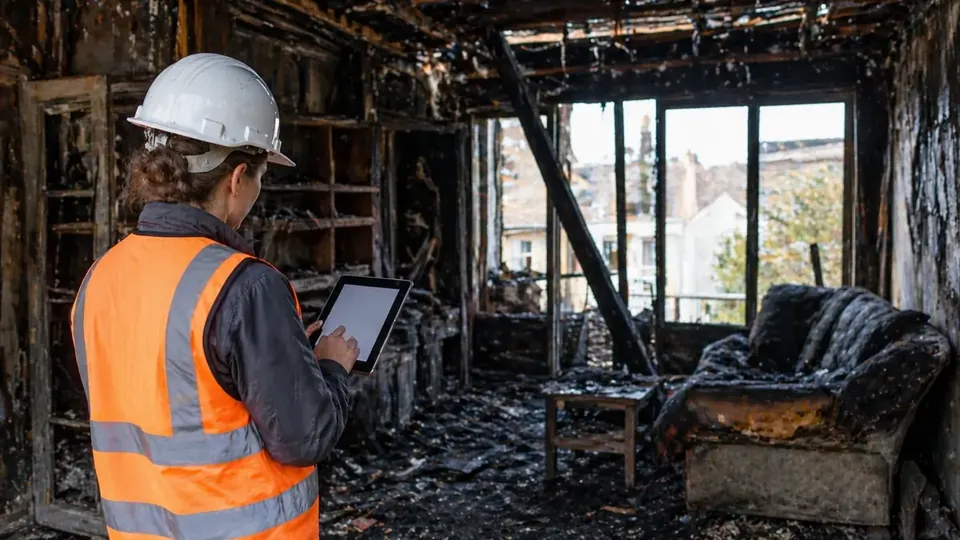
Fire damage insurance claims in McAllen are often the largest and most complicated claims a property owner will ever file. Beyond the visible burn damage, a fire can involve heat damage to framing and wiring, water damage from firefighting, smoke contamination throughout the building, and the loss of nearly everything inside. Each of those falls under a different part of the policy, with its own limits and documentation requirements.
This page outlines what a fire claim typically covers and where disputes arise. For smoke-only or smoke-heavy losses, see our smoke damage claims page.
Types of Property Damage Covered in Fire Claims
| Coverage | What it typically includes |
|---|---|
| Dwelling / building | Structural framing, roof, walls, electrical, plumbing, HVAC, finishes, and built-ins damaged by fire, heat, smoke, or firefighting water. |
| Other structures | Detached garages, carports, sheds, and fences. |
| Personal property / contents | Furniture, clothing, electronics, appliances, and business personal property. |
| Additional living expense (ALE) / loss of use | Increased costs for temporary housing, meals, and related expenses while the home is unlivable. |
| Business income | Lost income and continuing expenses for commercial properties, if purchased. |
| Debris removal | Demolition and hauling of fire debris, often subject to a separate or additional limit. |
| Ordinance or law | Increased costs to meet current building codes, if the coverage is included. |
Typical Documentation for a Fire Claim
- Fire department incident report and, if applicable, fire marshal findings.
- Photos and video of each room and the exterior before demolition or cleanup.
- A room-by-room contents inventory with descriptions, ages, and replacement costs.
- Receipts, bank or card statements, and older photos showing what you owned.
- An itemized building estimate, often prepared in Xactimate, and Matterport 3D scans where helpful.
- ALE receipts: lodging, meals above normal costs, mileage, laundry, and storage.
- Your full policy, declarations page, and endorsements.
Our claim documentation checklist is a helpful starting point.
Common Claim Issues and Insurer Arguments
- Scope of structural damage. The estimate limits repairs to the burn area and overlooks heat-damaged framing, wiring, or roof decking elsewhere.
- Clean vs. replace. The insurer proposes cleaning materials and contents that may need replacement.
- Contents depreciation. Aggressive depreciation on clothing, furniture, and electronics.
- ALE disputes. Disagreements over the length of displacement or comparable housing.
- Cause and origin. Investigations can delay the claim, and the insurer may raise exclusions if it believes the fire was intentional or the property was vacant.
- Code items. Upgrades required by the City of McAllen are denied or capped.
Insurance Settlement Considerations
- Deductible. Fire losses usually fall under the all-other-perils deductible, not the wind/hail deductible.
- ACV vs. RCV. Building and contents are often paid at actual cash value first, with recoverable depreciation released after repair or replacement. See RCV vs. ACV in Texas.
- Coverage limits. Each coverage part has a separate limit; special limits often apply to jewelry, firearms, cash, and collectibles.
- Ordinance or law. A major rebuild in McAllen must comply with the 2024 ICC codes effective January 1, 2026, and a permit from Building Permits & Inspections. Code upgrades are covered only to the extent of your ordinance or law coverage. See McAllen building codes.
- Debris removal. Check whether debris removal is included within the dwelling limit or provided as additional coverage.
Our claim calculator can help you see how depreciation and deductibles interact.
Building a Contents Inventory After a Fire
For many households, the contents list is the hardest part of a fire claim. It can include hundreds or thousands of items, and most people do not have receipts for everything they own. A few practical steps make the job more manageable:
- Go room by room. Walk through each room in your memory, wall by wall, including closets, drawers, cabinets, the garage, and the attic.
- Use photos you already have. Family photos, social media posts, and old videos often show furniture, electronics, and décor in the background.
- Pull purchase records. Online order histories, store loyalty accounts, and card statements can confirm brands, models, and dates.
- Record age and condition. Insurers use age and condition to calculate depreciation, so honest, specific information helps avoid disputes.
- Separate cleanable from non-salvageable items. Some items may be restored by a contents cleaning company; others will not survive heat or smoke.
Submit the inventory in an organized format and keep a copy of everything you send.
How a Public Adjuster May Help
A licensed Texas public adjuster can inspect the structure, prepare a detailed building estimate, organize the contents inventory, track ALE, and present the claim to the insurer. Joseph Dittman, a licensed Texas public adjuster, has experience across fire and other catastrophe losses. If your fire claim has been reduced or denied, see underpaid claims or denied claims. We cannot guarantee any particular outcome. Fees are disclosed in a written contract before any work begins; Texas law caps public adjuster compensation at 10% of the insurance settlement.
Policyholder Responsibilities
- Notify your insurer promptly after the fire.
- Secure the property: board-up, fencing, and roof tarps to prevent further damage or theft.
- Do not throw out damaged contents until they are documented and the insurer agrees.
- Submit a sworn proof of loss within the policy deadline if requested.
- Cooperate with the investigation, including recorded statements or an examination under oath when the policy requires it.
Applicable Policy Limitations and Exclusions
Fire claims can be limited by intentional act exclusions, vacancy or unoccupancy provisions, special limits on certain personal property, time limits on ALE, ordinance or law limits, and deadlines to complete repairs to recover depreciation. Policies may also set a deadline to file suit. For legal questions, consult a Texas attorney.
Frequently Asked Questions
What does fire insurance cover in Texas?
Most homeowners and commercial property policies cover fire damage to the building, personal property, additional living expenses or business income, and debris removal, subject to limits and exclusions. Your declarations page shows each limit.
Do I have to list every item that burned?
Generally, yes. Insurers usually require an itemized contents inventory. Photos, videos, receipts, bank records, and room-by-room memory help rebuild the list.
Will insurance pay for hotel or rental costs after a fire?
If the home is unlivable because of a covered loss, additional living expense (loss of use) coverage typically pays the increase in living costs, up to the policy limit or time period.
Does insurance pay for code upgrades during a fire rebuild?
Only if your policy includes ordinance or law coverage, and only up to its limit. McAllen adopted the 2024 ICC codes effective January 1, 2026.
Can a public adjuster help with the contents inventory?
Yes. Contents inventories are often one of the most time-consuming parts of a fire claim, and a public adjuster can help organize, price, and present them.
What if the insurer requests an examination under oath?
Many policies allow the insurer to request a recorded statement or examination under oath. Because this is a legal proceeding, consider consulting a Texas attorney before it takes place.