
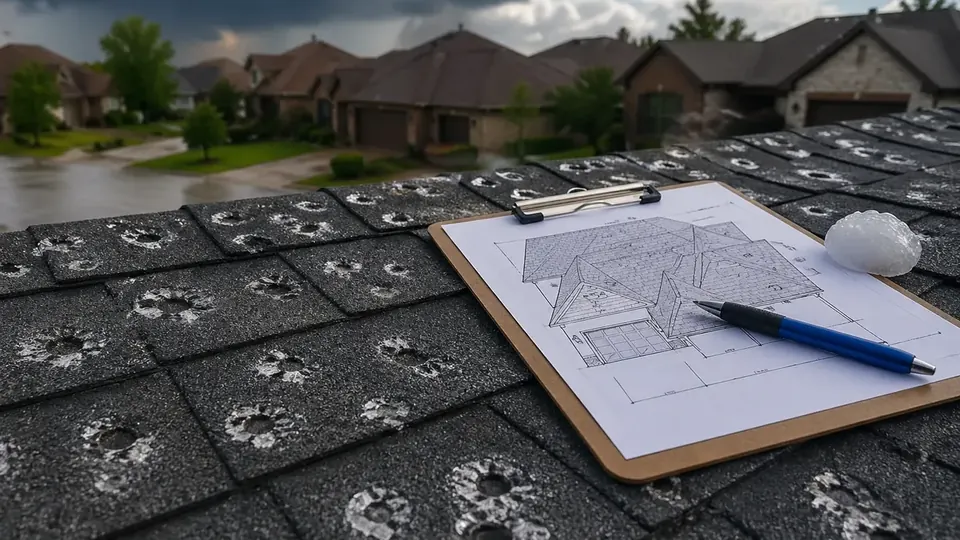
McAllen hail damage claims are some of the most common property insurance claims in the Rio Grande Valley (RGV). NOAA Storm Events data for Hidalgo County shows that hail reports cluster heavily in April and May, and several storms have produced very large stones. On April 20, 2012, softball-size hail was reported at McAllen High School, and on April 21, 2023, up to an hour of continuous hail fell across southern Hidalgo County, with baseball-size stones reported near Peñitas and McCook. More recently, the May 8, 2025 supercell produced reports of hail up to 3 inches in north McAllen (NCEI event record).
Hail damage is often harder to see than it looks. Bruised shingles, cracked tiles, and dented metal can be missed from the ground, and the full scope may only show up during a close roof inspection. This page explains what a hail claim usually involves, where disputes arise, and how a public adjuster in McAllen may help. For deeper background, see our McAllen storm history page.
Types of Property Damage Covered by Hail Claims
Hail is a named peril on most homeowners and commercial property policies, subject to deductibles, exclusions, and endorsements. Hail claims in McAllen frequently involve:
- Roofs – composition shingles (granule loss, bruising, fractured mats), clay or concrete tile, metal panels, and low-slope commercial membranes. See our roof damage claims page.
- Windows and skylights – broken glass, damaged frames and screens.
- Exterior walls – spatter and chips on stucco, cracked vinyl or fiber cement siding, damaged trim.
- Soft metals and equipment – gutters, downspouts, roof vents, and condenser coil fins on AC units.
- Other structures – fences, carports, sheds, and metal outbuildings.
- Interior damage – water intrusion through broken windows or punctured roofing.
Typical Documentation for a Hail Damage Claim
Good documentation ties the damage to a storm date and shows the full scope of repairs. Our claim documentation checklist covers this in more detail.
| Document | Why it matters |
|---|---|
| Date-stamped photos and video | Shows hail size, roof condition, and damage before repairs or tarping. |
| Weather records (NOAA, NWS) | Helps confirm hail fell at or near the property on the date of loss. |
| Roof inspection report with test squares | Records hits per square, mat fractures, and functional damage. |
| Itemized repair estimate | Line-item scope (often in Xactimate) for roofing, gutters, windows, and interior work. |
| Policy and declarations page | Confirms deductibles, roof payment schedules, and cosmetic damage endorsements. |
| Receipts for emergency repairs | Supports reimbursement for tarping and mitigation. |
Common Claim Issues and Insurer Arguments
Hail claims are often disputed on the details. Arguments we commonly see include:
- “Wear and tear, not hail.” The insurer attributes granule loss or cracking to age, blistering, or manufacturing defects.
- “Prior storm.” The carrier says damage happened before the policy period or during an earlier, unreported storm. McAllen often sees multiple hail days in a single season, which makes dating the damage important.
- “Cosmetic only.” Dents to metal roofing or soft metals are labeled cosmetic under an exclusion endorsement.
- Repair versus replace. The estimate allows spot repairs even when discontinued or brittle materials cannot be matched or repaired without further damage.
- Missing line items. Drip edge, starter course, ridge, flashing, and code-required underlayment are left off. Our insurance estimate review looks for these gaps.
Insurance Settlement Considerations
Several policy features shape what a hail claim actually pays:
- Wind/hail deductibles. Many Texas policies carry a separate deductible, often a percentage of the dwelling limit. Check your declarations page.
- ACV vs. RCV. Under replacement cost coverage, insurers typically pay actual cash value first and release recoverable depreciation after repairs are completed. Some roof coverage is ACV-only or follows a payment schedule. Read more in replacement cost vs. actual cash value in Texas.
- Ordinance or law. The City of McAllen adopted the 2024 ICC codes effective January 1, 2026. Code-required upgrades during a re-roof are only paid if your policy includes ordinance or law coverage, up to its limit. See McAllen building codes.
- Limits. Other structures and personal property have their own limits.
You can estimate how deductibles and depreciation affect a payment with our claim calculator.
Hail Damage Beyond McAllen City Limits
Hail swaths in Hidalgo County rarely stop at a city line. The April 2023 storm hit Peñitas, La Joya, and Mission especially hard, while the 2012 storms crossed McAllen, Mission, Pharr, and Edinburg. If your property is anywhere in the Rio Grande Valley (RGV), the same documentation steps apply. See our service areas for the communities we serve.
How a Public Adjuster May Help
A licensed Texas public adjuster represents the policyholder, not the insurance company. On a hail claim, that may include inspecting the property, reviewing the policy, preparing a detailed estimate, gathering weather data, and communicating with the insurer’s adjuster. If the claim has already been paid low, we can review it for an insurance claim supplement or discuss whether appraisal fits a dispute over the amount of loss. We cannot guarantee a result; outcomes depend on your policy and the facts. Fees are disclosed in a written contract before any work begins; Texas law caps public adjuster compensation at 10% of the insurance settlement.
Policyholder Responsibilities
- Give prompt notice of the loss to your insurer.
- Mitigate further damage – tarp roof openings and board broken windows, and keep receipts.
- Preserve evidence – photograph damage and keep samples of damaged materials when practical.
- Submit a proof of loss if requested, within the time the policy requires.
- Cooperate with inspections and reasonable requests for documents.
Applicable Policy Limitations and Exclusions
Common limitations on hail claims include cosmetic damage exclusions (frequently on metal roofs), roof surface payment schedules, ACV-only roof endorsements, exclusions for wear and tear or deterioration, and contractual deadlines for completing repairs to recover depreciation. Many policies also include a deadline to file suit. If you have legal questions about deadlines or a dispute, consult a Texas attorney. If a hail claim has been denied, ask the insurer to explain the denial in writing and identify the policy language it relied on.
Frequently Asked Questions
How long do I have to report hail damage in McAllen?
Most policies require “prompt” notice, and some set a specific window for reporting wind and hail losses. Check your policy conditions and report as soon as you discover damage. Delays can make it harder to tie the damage to a specific storm date.
Will the insurer pay for a full roof replacement after hail?
It depends on the extent of the damage, whether the damaged materials can be repaired or matched, and your policy terms. Some losses support replacement; others are scoped as repairs. A detailed inspection and estimate help show which applies to your roof.
What is cosmetic hail damage?
Some policies, especially for metal roofs, contain a cosmetic damage exclusion that removes coverage for dents that do not affect the function of the roof. Whether a dent is “cosmetic” or functional is a common dispute. Read your endorsements carefully.
How do I prove which storm caused my hail damage?
Dated photos, NOAA Storm Events records, local hail reports, and the condition of soft metals (vents, gutters, AC fins) can help connect the damage to a specific date. Our storm lookup tool is a good starting point.
Is my wind and hail deductible different from my regular deductible?
Often, yes. Many Texas policies use a separate wind/hail deductible expressed as a percentage of your dwelling (Coverage A) limit. Your declarations page shows the amount.
Can a public adjuster guarantee a bigger hail settlement?
No. A public adjuster can help document the loss, review the insurer’s estimate, and present the claim, but no one can guarantee an outcome. Results depend on the policy and the facts.